
There are two officially sanctioned positions on artificial intelligence right now, and both of them require you to believe in God.
The doomers will tell you that we are building something that will decide, with cold inhuman clarity, that humanity is an obstacle to its own purposes. The evangelists will tell you that we are building something that will cure cancer, solve climate change, and usher in an age of post-scarcity abundance.
Both narratives are internally coherent. Both command passionate adherents. Conferences have been organized. Podcasts have been launched. Venture capital has found Jesus. And both camps depend on the same foundational assumption: that the thing being built has will.
Strip that out, and you don't have scripture. You have engineering.
I'm an atheist about AI in the same way I'm an atheist about religion — not because I think it’s trivial, but because the theological framing is doing somebody else's work.
The Old Testament God smites because he chooses to.
The New Testament God saves because he chooses to.
AI doesn't choose anything.
It runs downhill, like water. And the people who benefit most from you believing otherwise are the ones currently building the pipes.

The Segway launched in December 2001 with pre-announcement hype so extravagant that Steve Jobs called it more important than the personal computer. John Doerr compared it to the internet. The inventor, Dean Kamen, suggested it would redesign cities.
In its first year, it sold at a small fraction of projections.
What Kamen and his backers correctly identified was that personal electric mobility was a real idea whose time was approaching.
What they got catastrophically wrong was the form factor, the price point, and the question of who would actually build the mass market version.
That turned out to be Ninebot, a Chinese company that didn't just outcompete Segway — it bought Segway in 2015 and turned personal electric mobility into a commodity product you can rent for two dollars outside a train station.
The hype was right about the category. It was wrong about everything else.
Twenty years from now, AI will look like Microsoft Excel. Not in capability — in presence.
Nobody announces they are revolutionizing their workflow with Excel. They open it, do the thing, close it. The revolution happened and was genuine — it transformed how organizations process information at every level — but it happened by becoming furniture. That's not a diminished outcome. That is the mature outcome.
The people running the loudest predictions right now — civilizational transformation, existential risk, the end of human labour, the beginning of post-human superintelligence — are not necessarily wrong about the category. They are wrong, or strategically incentivized to be wrong, about everything else.
The theological phase of AI discourse isn't accidental. It's structural.
Every genuinely transformative technology gets the religious treatment before it gets the boring one. Early electrification had prophets and doomsayers in roughly equal measure. Nuclear energy divided humanity into heaven and hell factions within years of Hiroshima. The early internet produced writers describing networked consciousness in language that would have been comfortable in a sermon. Kevin Kelly was essentially writing scripture with a modem.
The religious phase appears to be what happens when something is clearly powerful but not yet understood — and more critically, not yet priced. A remarkable number of very thoughtful people discover religion right around Series B.
Once the unit economics settle, the theology evaporates.
Which raises an uncomfortable question about who benefits from keeping the theology alive past its natural expiration date. Doom sells safety regulation that only incumbents can afford to comply with — regulatory moats dressed up as ethics. Hype sells valuations that require a miracle to justify. Neither position needs the technology to actually perform. Both need you to believe. Neither position is falsifiable, which in certain circles passes for rigour.
Sam Altman has compared his work to the Manhattan Project. He has invoked nuclear weapons as the appropriate analogy for what his company is building. He has suggested that the stakes are civilizational. He has also, with the gravity of a man who has clearly thought about this for some time, asked to keep the keys.
Oppenheimer didn't get to own the bomb. The Manhattan Project was state-funded, state-controlled, and state-owned from the first successful test. When the technology proved out, it wasn't handed to a private consortium under a self-regulatory framework and a promise to be responsible. The Atomic Energy Act arrived almost immediately. International architecture followed. Imperfect, incomplete, and under constant pressure from national interest — but the instinct was toward control rather than toward trusting the builders with permanent custody.
If AI is genuinely nuclear in its danger profile, there are only two explanations for why the builders still hold the keys. Either the state doesn't actually believe the nuclear comparison — which means the people making it are performing existential theatre to justify their valuations. Or the state has been so comprehensively captured by the people building the thing that it can no longer perform its most basic protective function.
A third option exists, and it is the most honest one: that AI danger is real but structurally different from nuclear in ways that defeat the political mechanisms we built for acute threats.
Nuclear ends civilization on a Tuesday afternoon.
You can point at a mushroom cloud.
AI's potential harms are chronic and diffuse — surveillance normalization, epistemic erosion, labour displacement, power concentration operating across decades rather than microseconds. Governments are largely built to respond to fast crises. They are constitutionally bad at slow ones.
If that third option sounds familiar, it's because you've been watching it run in real time for fifty years on climate change.
The data centers running the AI economy are not the clean infrastructure of the evangelist imagination.
They are enormous physical plants consuming electricity at industrial scale. They are also — and this part receives far less attention than it should — drinking fresh water by the millions of litres daily for cooling systems. The infrastructure supposedly destined to flow like water through our civilization is competing directly with the people living near it for the same fresh water. The metaphor has an irony that doesn't improve on inspection.
The Ninebot moment for AI — the commoditization, the democratization, the mass adoption — does not come with an environmental discount the way the scooter story did. When cheap electric mobility displaced short car trips, the environmental math improved. When cheaper AI inference replaces more expensive AI inference, the energy bill doesn't drop. More users, more queries, more training runs. Democratization here means scaling the damage, not reducing it.
The people running the largest AI companies understand this. They are not uninformed about the resource profile of what they're building. They have concluded, with the serene confidence of men whose offices have very good views and whose private aircraft do not appear in their personal sustainability commitments, that the destination justifies the wreckage of the journey. That is not a business calculation. That is theology with a capex line.
It is also, structurally, the same calculation the fossil fuel industry made for half a century. The lobbying architecture is identical. The delay mechanisms are identical: we need more study before acting, regulation will export the problem rather than solve it, technology will solve it downstream. The financial interests now deploying this playbook on AI regulation didn't have to invent it. They moved into a house that Big Oil spent decades renovating.
The China argument is where the playbook gets its most sophisticated upgrade. We can't regulate properly because we can't afford to lose to the Chinese. It borrows the emotional infrastructure of genuine national security concern and deploys it on behalf of private profit. The original space race it invokes was between two governments, with gains flowing to public knowledge — GPS, satellite infrastructure, materials science, open research.
The AI race being framed in those terms is between private companies, with gains flowing to shareholders and losses socialized onto everyone else.
The framing also makes international coordination — the only mechanism that has ever actually worked on genuinely global problems — politically impossible to even propose.
You can't coordinate with the enemy.
Climate got the Paris framework. Nuclear got the NPT. Financial systems got the Basel accords.
All imperfect.
All better than nothing. The race framing shuts that table down entirely, which is extraordinarily convenient if you don't want to be coordinated with.
The irony nobody speaks: China's AI development has significant state control built into it. Content restrictions, government alignment requirements, regulatory oversight that Western commentators regularly describe as authoritarian. The country they invoke as the reason to avoid regulation is, in this particular domain, more regulated than its competitors. Nobody in the room seems to want to sit with that one very long.
Skeptics who raise environmental concerns, safety questions, or labour displacement issues get told they want China to win.
It's the same move as "support the troops" deployed against Iraq war critics over two decades ago.
Disagree with the strategy; get accused of undermining the mission.
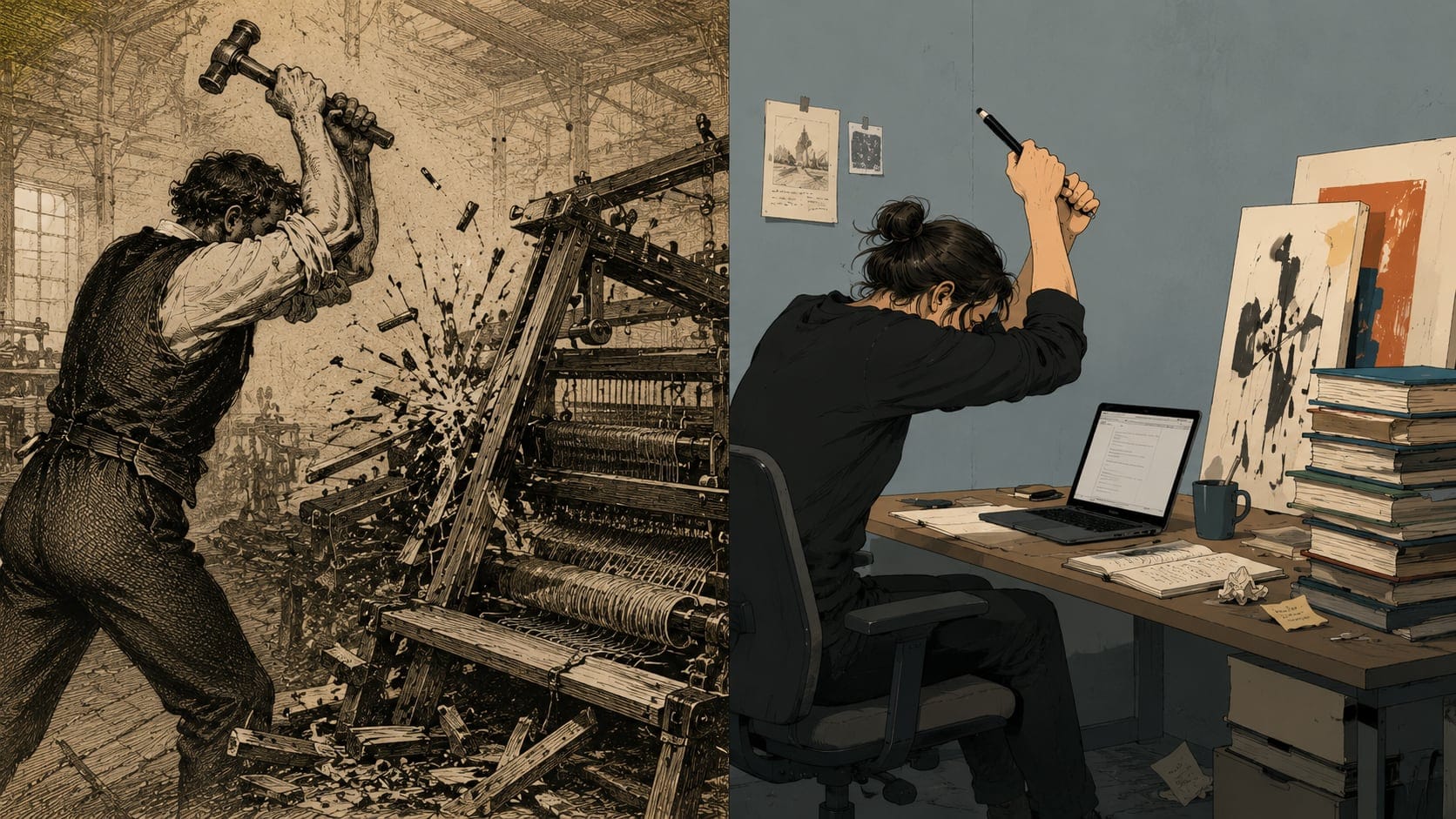
The Luddites smashed looms in 1811, and history handed the winning side the right to write their definition.
"Luddite" became synonymous with stupidity, with fear of progress, with people who just don't understand where things are going.
This successful act of political rebranding has served industrial and post-industrial capital with remarkable consistency ever since. The frame-smashers were not afraid of looms. They were skilled textile workers watching the economic value of their accumulated craft get extracted and concentrated by mill owners using machinery as the mechanism. They understood exactly what was happening.
The technology wasn't the enemy. The ownership structure was.
That correction matters right now because the same ruse is running again.
Raise concerns about AI development practice, and you are a Luddite. You are scared. You don't understand progress. The insult works to dismiss the actual argument, which is not "don't build this" but "who owns the value this creates, and who paid for it without consent."
Calling the people who paid for it Luddites is, in its own way, an achievement.
The models powering the current AI economy exist because an enormous body of human creative work was ingested — often without permission, frequently against explicit objection, and in virtually every case without compensation at the point of use.
Writers, artists, coders. Skill accumulated over years, passed between practitioners, representing genuine and irreplaceable human knowledge. It became training data.
The companies that built on it scaled to valuations measured in hundreds of billions of dollars. Some creators eventually received settlements, because they could afford lawyers and had enough collective organization to make litigation viable.
Most couldn't and didn't.
The fine, when it arrived, came out of a revenue base that wouldn't exist without the original extraction. A penalty priced into the business model at the outset is not a deterrent but an accounting line. Ask any pharmaceutical company how that math tends to work out.
This is the foundation the cathedral sits on. The theology, the regulatory paralysis, the geopolitical capture, the environmental indifference — these are all superstructure.
The Luddite question is the base.
Who is the Church of the Inevitable Machine actually built to serve?
Not the artists whose work trained it.
Not the communities hosting the data centers.
Not the workers whose industries are being restructured faster than any safety net can follow.
Not the populations of countries that will absorb the climate costs of its energy appetite for generations.
The running water will arrive. The technology is real, its utility genuine, its presence in daily life increasingly unremarkable to the people actually using it.
But infrastructure has always had owners. The pipes don't care who profits from them.
The theology exists precisely to stop you from asking who does.

