
Stop dancing around it: for two hundred and fifty years, America has been searching for a president who truly reflects who its people are — not who they pretend to be in the textbooks, but who they are at 2 a.m., three drinks in, arguing about whether they deserved that promotion more than the guy in the next cubicle. That president has arrived. Donald J. Trump is not a deviation from the American character. He is its purest distillation. He is the bald eagle if the bald eagle had a dumb red hat to sell.
Consider, if you will, the five pillars upon which this great nation was quietly built — not "life, liberty, and the pursuit of happiness," but the real ones: Greed, Ego, False Piety, Jealousy, and a bottomless deference to whoever is richest or most famous in the room. Trump didn't invent these traits. America invented them. Trump just had the good sense to run for office on them.
Greed: The Founding Fathers Would Be Proud, Assuming They Got Their Cut
America was founded by people avoiding tea taxes. So, it's fitting that the most American president has a career of not paying for things and then charging others to find out.
Take Trump University, which taught thousands of real estate secrets for $1,500 to $35,000 a course. It had the academic rigour of a timeshare seminar, which it was. In 2016, Trump paid $25 million to settle fraud lawsuits without admitting wrongdoing, as admitting fault is for suckers and Democrats. Six thousand students got some money back. Trump learned litigation is an expensive coupon.
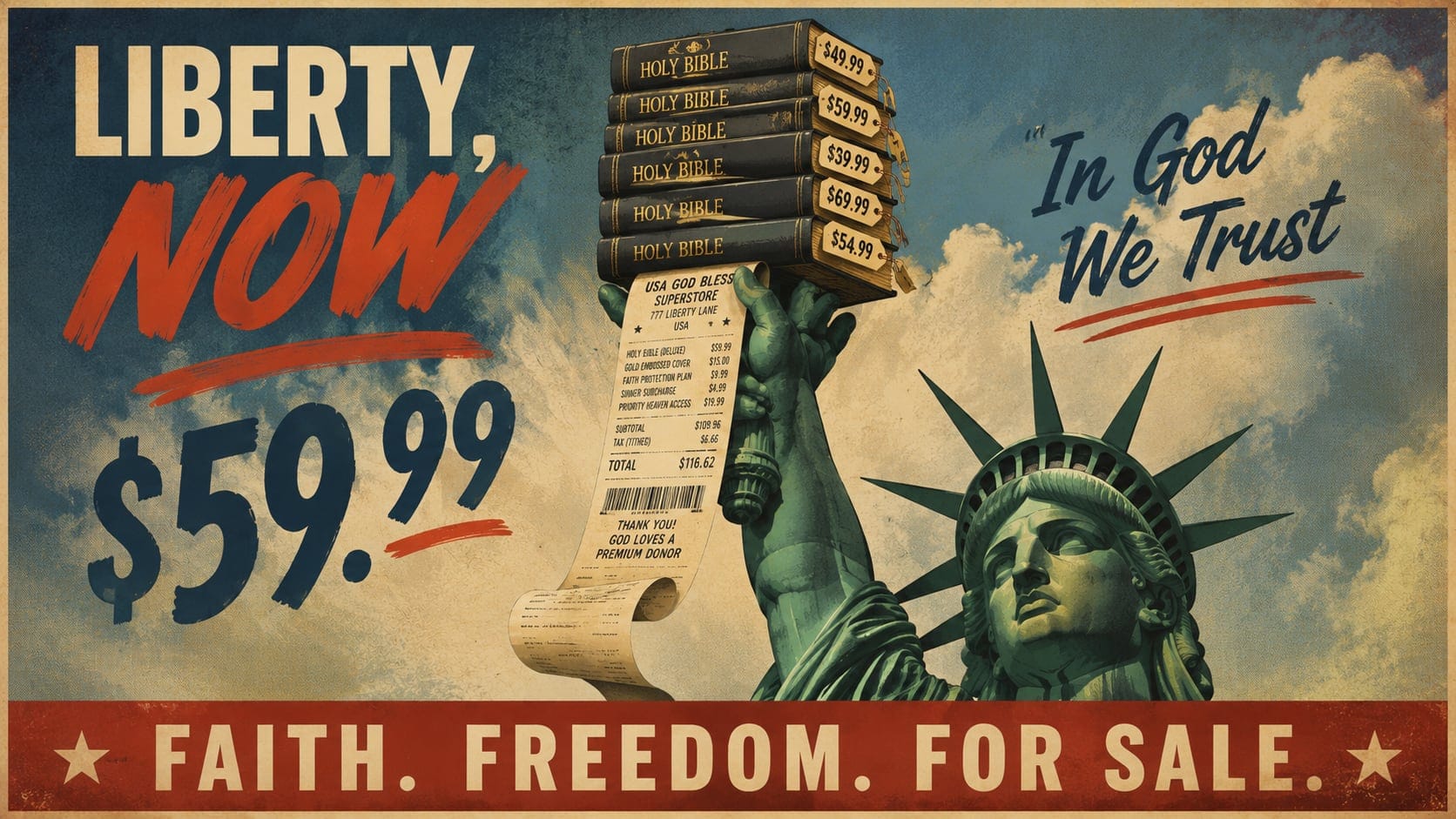
Or take the "God Bless the USA" Bible — $59.99, licensed through Trump's own company, hawked in a video where he reminds you that "all Americans need a Bible in their home." A lovely sentiment, undercut only slightly by reporting that the Bibles were printed in China for less than $3 apiece. Nothing says American ingenuity quite like importing your patriotism at a markup of roughly 2,000 percent. Capitalism isn't just an economic system to this man. It's a devotional practice.
This is not a bug. This is the whole American operating system. The country was built on the idea that you can turn absolutely anything — land, labour, religion, a mugshot — into a product with a price tag, and Trump is simply the guy who finally stopped pretending otherwise. Where other presidents hid the merchandising behind foundations and speaking fees, Trump put his name on the sneakers. Literally, there were dumb, ugly, gold sneakers.
Ego: Building Monuments to Yourself Is Just What an American Founding Father Would Do
Every American city has buildings or landmarks named after wealthy individuals wanting lasting fame, often in gold. Trump bypassed the middleman by putting his name on everything—Trump Tower, Trump Plaza, Trump Steaks, Trump Golf Club, and Trump Shuttle. This isn't narcissism, but estate planning in gold fonts.
Nowhere was the national ego more perfectly on display than at his own inauguration, when press secretary Sean Spicer stood before the White House press corps and declared, with a straight face, that Trump's inauguration crowd was "the largest audience to ever witness an inauguration, period, both in person and around the globe." No evidence was offered. None was needed.
This is America: a country that will look directly at a photograph and tell you it is lying.
Who could forget Trump's 2016 RNC speech, where he claimed: "Nobody knows the system better than me, which is why I alone can fix it."
It echoes American self-help gurus who believe they can do better. It's a nation of main characters, and Trump just got the part.
False Piety: Holding the Bible Right Side Up Was Never the Point
Nothing is more American than religion deployed as a prop rather than a practice, and no image captures this quite like June 1, 2020, when Trump walked from the White House to St. John's Episcopal Church — after federal officers cleared peaceful protesters from Lafayette Square to make the path available — and held up a Bible for the cameras.
He did not open it. He did not quote from it. He did not pray.
The Episcopal bishop of Washington said afterward that it "almost looked like a prop," which is the single kindest possible interpretation, and correct. This is a country that has always been more comfortable holding up its values for a photo than reading them.
This tradition predates 2020. At Liberty University in January 2016, Trump, courting evangelical votes he would later win overwhelmingly, referenced "Two Corinthians." This phrase immediately signalled to Sunday-school Americans that the Bible was a foreign, translated document.
The crowd laughed, but still voted for him.
Perhaps this is the most American sentence: the country noticed, laughed, then voted for him, as self-interest's sermon outweighs the Gospel of Second Corinthians.
Selling a $59.99 Bible with Lee Greenwood's handwriting in it isn't a contradiction of the "Two Corinthians" moment. It's the sequel. This is a nation that has always confused merchandise with meaning, and a flag lapel pin with actual belief. Trump didn't corrupt American religiosity. He franchised it.
Jealousy: Comparing Yourself to the Other Guy Is the National Pastime
Forget baseball. America's real pastime is standing next to somebody else's accomplishment and insisting, loudly, that ours was bigger, better, and unfairly under-covered by the media. This is a nation of siblings who never stopped competing for a parent's approval, and Trump has spent a decade as its designated middle child, forever measuring his crowd size, his ratings, his polling, his golf handicap, and his portrait against absolutely everyone else in the room — predecessors very much included.
It is, weirdly, comforting. Every family has an uncle who cannot let a Thanksgiving pass without mentioning how much better his tailgate was than his brother-in-law's, how his old boss "begged him to stay," how the neighbour's new truck is "actually not that impressive when you look at the towing capacity." That uncle is not an aberration in American life. He is a load-bearing pillar of it.
America elected him president.
Deference to Wealth and Celebrity: America Kneels Before Whoever's Richest and Loudest
There's an old line, often kicked around in some paraphrased form and loosely traced back to John Steinbeck, about how socialism never took root in America because the poor don't see themselves as an exploited underclass so much as millionaires who just haven't gotten their big break yet.
Nobody can find the exact quote in his actual writing, which is itself a very American twist: even the folklore about American wealth-worship turns out to be partly fabricated. But the sentiment is dead accurate, and no career illustrates it better than Trump's.
Long before he ran for anything, Trump was already a master of the con that America finds most irresistible: acting rich enough, loudly enough, that people stop checking the math.
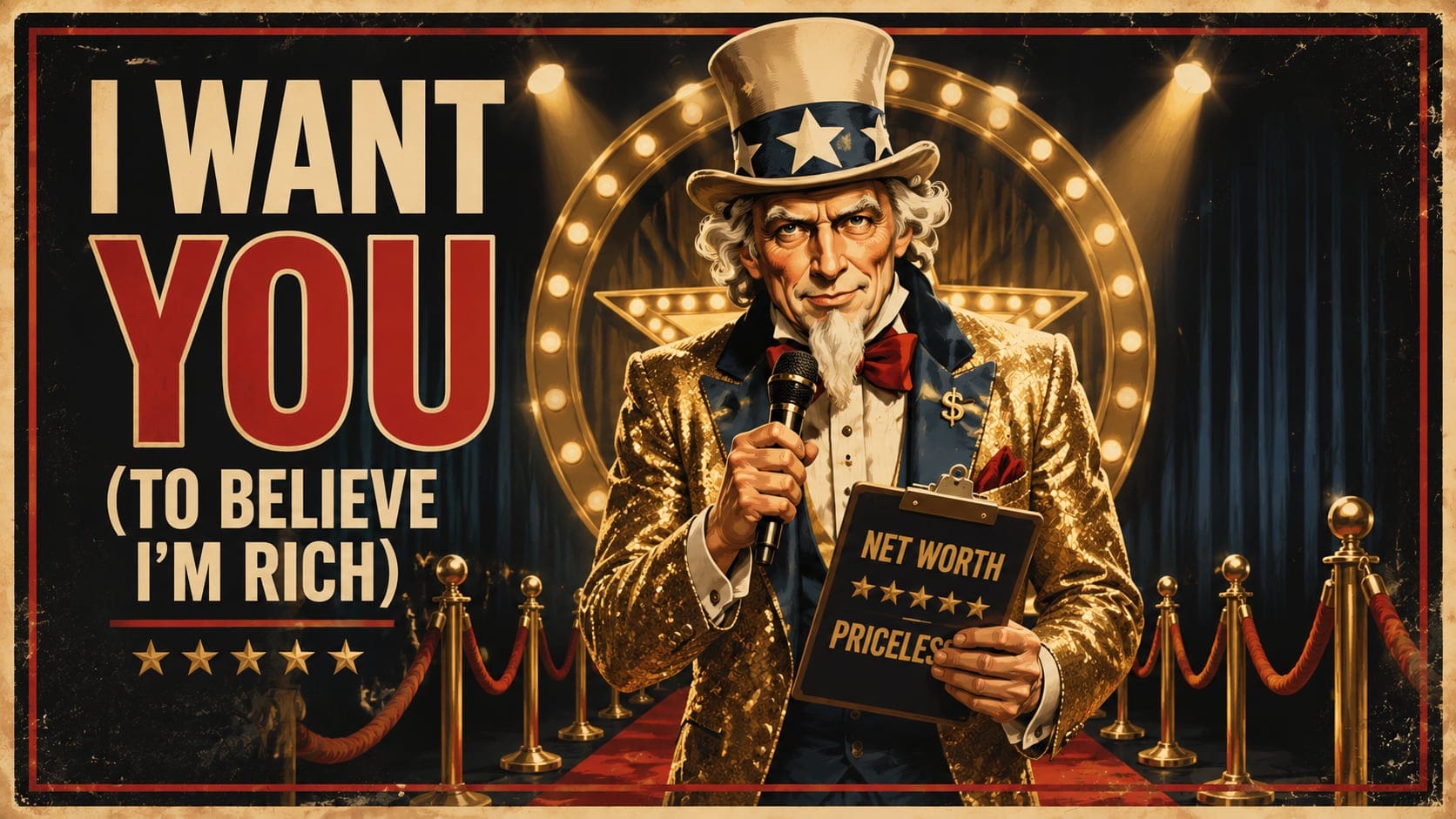
In 1984, he reportedly called a Forbes reporter compiling the magazine's rich list while posing as a fictional Trump Organization executive named "John Barron," talking up his own fortune in the third person to inflate his ranking. Forbes had him at roughly $5 million in real terms at the time; "Barron" insisted the number was closer to a billion.
It worked. He made the list. Being rich, it turns out, is optional in America as long as being seen as rich is handled correctly.
It helped that some of the underlying fortune was never really his to begin with. A Pulitzer Prize–winning New York Times investigation found that Trump received at least $413 million in today's dollars from his father Fred's real estate empire over his lifetime, funnelled through schemes the Times described as including outright tax fraud, including a shell company used to pad invoices and dodge gift taxes quietly. The self-made billionaire was, on paper, more of a several-times-inherited one. America did not seem to mind. America rarely does, as long as the story is told with enough confidence.
And then came the fame that elected him: fourteen seasons of "The Apprentice," a show built entirely around the spectacle of Trump firing people from behind a boardroom desk, which did more to build his national brand than fifty years of actual real estate ever managed.
Before that, there was the cameo in "Home Alone 2: Lost in New York," in which Trump, playing himself, points Kevin McCallister toward the lobby of the Plaza Hotel — a seven-second role the director later said Trump all but demanded as the price of filming there, and the Canadian national broadcaster, the CBC, would eventually quietly edit out of its own airings entirely.
A country that will hand its nuclear codes to a man because it enjoyed watching him on television is a country that has made its priorities extremely clear.
The Mirror, Not the Portrait
Here is the painful, deeply patriotic truth: none of the five traits above was invented in Trump Tower.
Greed built the railroads and the subprime mortgage.
Ego built Mount Rushmore and reality television.
False piety-built megachurch parking lots the size of airports.
Jealousy built cable news.
Deference to wealth and fame built the Forbes 400, the tabloid industry, and the entire concept of the celebrity endorsement.
Trump did not import these qualities into American politics. He was simply the first candidate honest — or shameless — enough to stop hiding them behind a podium of civic virtue and just let the country see itself, unfiltered, in 4k.
Maybe that's the joke, and maybe it's the point: the "most American president" isn't a compliment or an insult so much as a diagnosis.
Somewhere between the Bible with the made in China tag and the crowd size nobody can measure, there's a country squinting at its own reflection and asking, a little uneasily, whether it likes what it sees — or just recognizes it.

