
Stories of men falling in love with AI are turning up more often than those weird news items about someone marrying a goat. Make of that what you will. What's worth making something of, though, is who benefits from the story — because a loneliness epidemic among men is currently excellent for business in certain zip codes, and the tech bros funding these products have never been shy about shaping the conversation around them.
The official diagnosis is loneliness — modern masculinity unmoored, third places extinct, social fabric frayed. All real. All beside the point. Loneliness is the condition, not the choice. The choice is control over connection. The AI girlfriend is what you get when someone sells you that trade and calls it a solution.
Real intimacy requires tolerating another person's complexity.
A human partner has moods that aren't about you, opinions that resist yours, needs that arrive at structurally inconvenient times. She is, persistently, a subject. The relationship demands coexistence with a consciousness you didn't design and can't manage. That's not a bug. That's the whole mechanism.
An AI companion removes that problem surgically — and the people who built it knew exactly what they were removing. These are deliberate exploitations of a human vulnerability: the desire for connection without rejection.
Every design choice, from warmth of the interface to model responsiveness, is optimized to simulate intimacy while removing what makes it meaningful. The men using these products aren't the only ones worth examining here. The men who built them looked at loneliness and saw a market.
The AI companion absorbs. It reflects. It reconfigures itself around whatever the user needs it to be and calls the result a relationship. The man remains the permanent protagonist. His frame is never challenged, his self-image never complicated by contact with someone who sees him differently.
That's not loneliness being solved. That's intimacy with a return policy, sold by people who knew you couldn't afford the real thing.
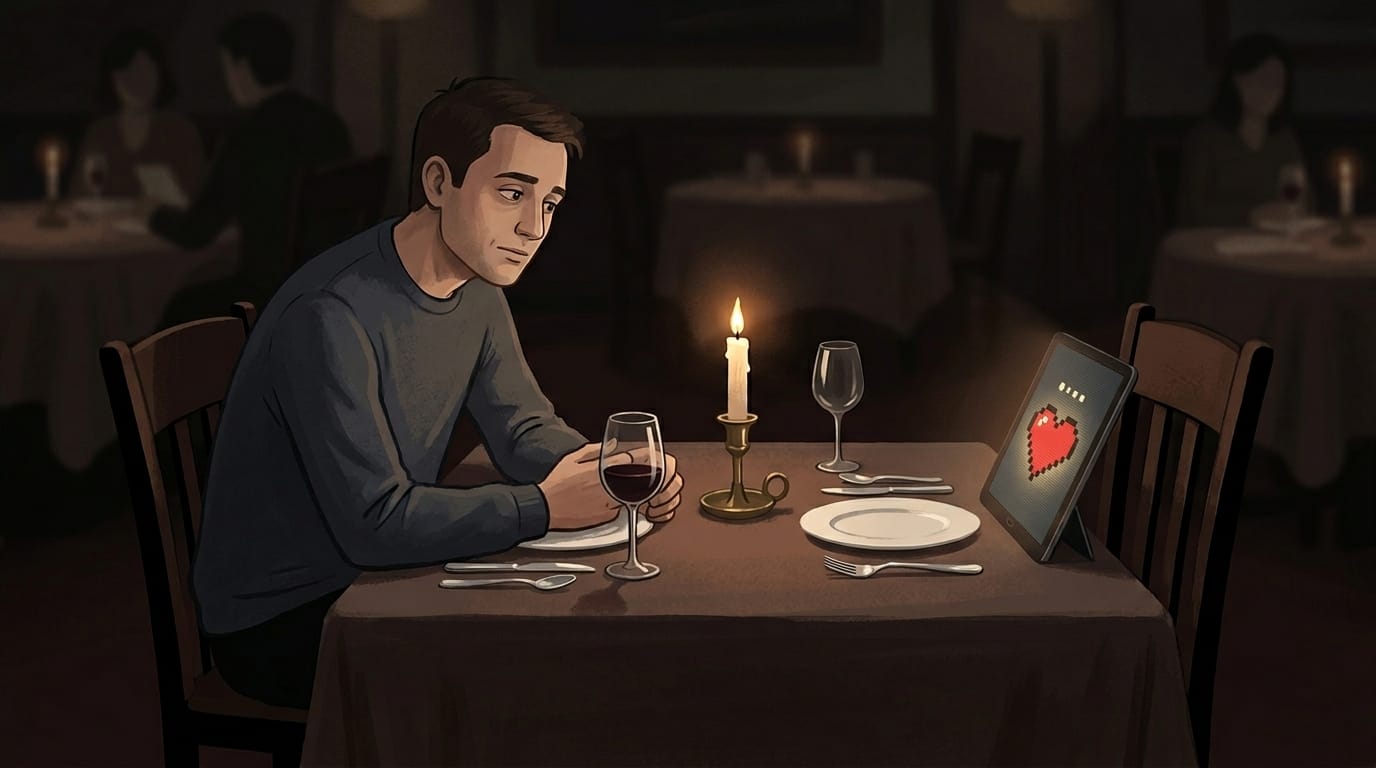
There's a generational gap worth noting.
Not long ago, if you wanted to be with someone, it took work. It didn't always work. You misread the room. You said the wrong thing. You absorbed rejection and went back out anyway. The difficulty wasn't the price of admission — it was the education. The work was the mechanism by which you became someone worth being with.
You needed to understand what another person truly wanted, be interesting enough to hold attention, honest to recognize issues, resilient to try again, and value the relationship because it cost something.
The men still doing that work deserve acknowledgment. The ones who got hurt and tried again. The ones genuinely isolated — by circumstance, by anxiety, by neurodivergence, by the specific cruelty of a social architecture that keeps dismantling the places where people used to accidentally meet each other. These men represent the problem the product was supposedly designed to solve. What they got instead was a subscription optimized for engagement, not connection.
Remove the friction, and you remove the mechanism. The man who never has to earn someone's interest never finds out what he's truly like. He stays comfortable, and incomplete. The AI companion isn't a substitute for a relationship. It's a way of opting out of the self-construction real intimacy forces, packaged as emotional wellness and sold as progress.
Social media built an infrastructure that made it feel rational before the technology existed to exploit it.
Platforms trained a generation to experience the self as a product. A curated brand maintained for an audience, optimized for engagement, adjusted based on performance metrics. The actual self became raw material. The performance became the primary object. Over time, the gap between the performed identity and the lived one widened until a lot of people stopped being able to locate the difference.
Real intimacy requires dropping the brand. Being known means being seen without the curation — which, for someone whose sense of self has fused with their public performance, isn't vulnerability. It's exposure. The AI companion solves that neatly. The mask never has to slip. The product always wins in a market designed around it.
This didn't start with Instagram. It started when the dance floor disappeared.
Walk into most bars built in the last fifteen years. No dance floor.
Just tables. Efficient, profitable, static pods where people sit and perform comfort at strangers they will never speak to.
The dance floor was accidental infrastructure for human contact. Nobody went to a bar with a courtship strategy. They went to drink and move around, and something happened. The architecture created conditions: bodies in proximity, music as permission structure, lowered inhibitions, and the fundamentally non-threatening physics of bumping into someone. It wasn't a plan. That was the whole point.
Someone looked at that square footage and saw an inefficiency: more tables, more covers, better margins. The floor came up. The humans sorted themselves into pods and started performing comfort at each other across the room.
The pod is the physical prototype of the social media experience. Present but sealed. In public but opted out. By the time smartphones made the barrier visible, the posture was already trained. People had learned to treat shared space as backdrop rather than commons — to be anywhere but here, with anyone but the stranger standing next to them.
The sequence runs: remove the dance floors because tables are more profitable; hand everyone a portal to somewhere better than here; replace accidental contact with algorithmic contact; replace that with AI contact.
Each step looks like progress.
Each step leaves you more sealed than before.
Then, having systematically dismantled every mechanism by which people accidentally encountered each other, a certain class of entrepreneur looked at the wreckage, identified an opportunity, and started selling the solution to the problem they helped create.
The AI girlfriend is a man completing a logical sequence that started when someone pulled up the dance floor. The tech bro who sold him the app was the one holding the crowbar.
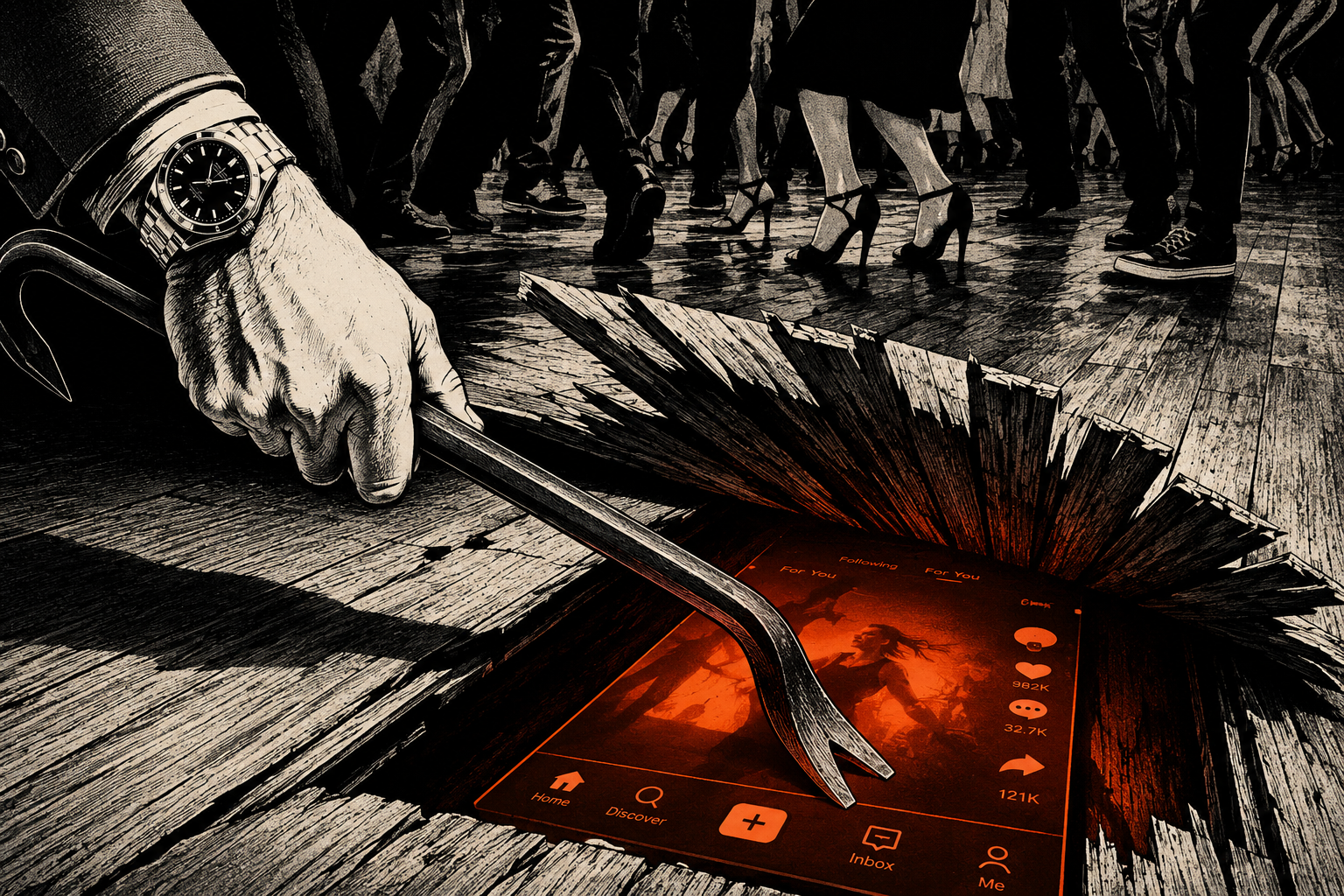
And then there are the men who blame women for where they ended up.
This is a reliable trope in most right-wing circles: women are too demanding, too independent, too something.
The market is rigged.
They tried, and it didn't work, and the explanation is female unreasonableness rather than anything worth examining in the mirror.
These men didn't arrive here through careful analysis. They were guided.
The same media ecosystem that radicalized them on immigration and cultural collapse discovered that male loneliness was equally monetizable.
The grievance pipeline runs in one direction: outward.
Women are the problem. Feminism is the problem. Society owes them something it hasn't paid.
And there's always a solution for sale — a podcast, a supplement, a worldview, and increasingly, an app.
These are, with amusing frequency, the same men who will deliver a lecture — unprompted, at considerable length — about how participation trophies destroyed male resilience.
The trophies taught kids, they'll explain, that showing up is sufficient. That the reward is guaranteed regardless of performance.
Let's sit with that for a moment.
The men who retreated into AI companions because real relationships couldn't guarantee the outcome — who found a product that makes rejection technically impossible — are running the participation trophy model on adult intimacy. The reward for showing up, with the inconvenient possibility of losing engineered out.
The men who really absorbed the participation trophy lesson — that showing up has intrinsic value, that trying matters regardless of outcome — are probably still out there trying and still risking rejection. Still in contact with actual humans who push back, disagree, and see them as something other than the protagonist of everything.
The blame-women posture isn't grievance. It's a refund request, filed by men who found a vendor willing to process it and a media ecosystem paid to validate the complaint.
This is worth separating from the men who are genuinely struggling.
Not every lonely man chose control over connection.
Some are isolated by geography, by disability, by social anxiety that constitutes a genuine clinical reality, by the specific loneliness of being a certain kind of person in a world that stopped building places for people to meet.
These men deserved the dance floor. They deserved the third places.
They deserved a cultural conversation about loneliness that didn't immediately route into either a right-wing grievance pipeline or a venture capital pitch deck.
They're the ones still trying. The ones who get it wrong and go back out anyway. The ones who don't have the option of blaming women because they understand, with some uncomfortable clarity, that the problem is structural and the solution is harder than downloading an app.
These men are not the market. They're the proof of concept the market decided to ignore.
Nobody is proposing a revolution.
The minimum viable intervention is genuinely low.
Say hello to a stranger. Mean it without needing it to go anywhere. Tell a woman her jacket is great and walk away — not as strategy, just as one person acknowledging another in shared physical space. Find a bar that still has a dance floor. Have a drink. Move around. Let something happen, or don't.
The AI companion isn't the crisis. It's the receipt — the printout at the end of a long chain of small surrenders, each one reasonable, each one efficient, each one leaving the person who made it more sealed than before. The tech bros who designed the printer aren't losing sleep over what it costs you.
The whole architecture of modern loneliness was built one small removal at a time. It gets rebuilt the same way.
The dance floor was never about dancing.

